
Redox flow batteries represent a fundamentally different approach to energy storage — one that is particularly well suited to the long-duration, large-scale requirements of the renewable energy transition. QuadriE is developing an aqueous organic redox flow battery (AORFB) that replaces expensive and toxic metals with abundant, safe organic molecules, combined with a novel cell design and membrane technology.
How Does a Redox Flow Battery Work?
A redox flow battery stores electrical energy in the chemical bonds of dissolved molecules — called redox-active species — held in two separate liquid electrolytes: the anolyte (negative side) and the catholyte (positive side). During charging, electrical energy drives electrochemical reactions that change the oxidation state of these molecules. During discharging, the reverse reactions release the stored energy as electricity.
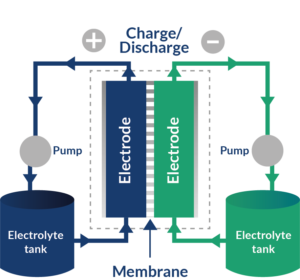
The two electrolytes flow through an electrochemical cell separated by a membrane. The membrane allows small charge-carrying ions to pass between the two sides for electrical balance, while blocking the larger redox-active molecules to prevent self-discharge.
The key advantage of this architecture is the decoupling of power and energy:
- Power is determined by the size and number of electrochemical cells
- Energy capacity is determined by the volume of electrolyte in the storage tanks
Why Organic? The Case Against Vanadium
The majority of commercially deployed flow batteries today use vanadium as the active material. Vanadium is effective, but comes with significant drawbacks: it is a critical raw material subject to supply risk and price volatility, requires concentrated sulfuric acid as the electrolyte (corrosive, hazardous), and carries a substantial environmental footprint from mining and processing.
Aqueous organic redox flow batteries (AORFBs) address all of these issues by replacing vanadium with organic molecules that can be synthesized from abundant, renewable feedstocks. The electrolyte is a mild aqueous solution — far safer to handle and more compatible with a circular economy.
Several companies are now developing AORFB technology, each with a distinct approach. What distinguishes QuadriE is the combination of a novel tubular reactor cell architecture and a proprietary size-exclusion membrane strategy — both developed and validated within the NewBat consortium.
| Vanadium RFB | QuadriE AORFB | |
|---|---|---|
| Raw material | Critical, price-volatile | Abundant organic molecules |
| Electrolyte | Concentrated sulfuric acid | Mild aqueous solution |
| Toxicity | Medium – High | Low |
| Circularity | Limited | High — renewable feedstocks |
| Cell architecture | Plate-and-frame (conventional) | Tubular reactor (QuadriE) |
| Membrane cost | High – commercial Cation Exchange membranes | Low — modified size-exclusion |
Active Materials: Benchmarking and Beyond
A key advantage of the organic flow battery approach is the breadth of molecules that can serve as redox-active species. QuadriE’s strategy is to develop a cell architecture and membrane platform that is not locked to a single redox couple, but can accommodate a range of organic active materials as the field matures.
For the current development phase, QuadriE uses two well-characterised organic redox couples as benchmark materials: disodium anthraquinone-2,7-disulfonate (Na₂AQDS) as the anolyte and tetrasodium hexacyanoferrate(II) (Na₄Fe(CN)₆) as the catholyte, both dissolved in aqueous ammonium sulfate. The overall cell voltage is approximately 0.585 V at an electrolyte concentration of 0.4 mol/L. The system operates at low pressure and near-ambient temperature, using no hazardous or corrosive chemicals.
Beyond the benchmark system, QuadriE is actively exploring alternative organic redox-active compounds — including naturally occurring molecules derived from organic residual streams. In collaboration with Wageningen University & Research (WUR), we are investigating whether electrochemically active compounds present in organic waste streams can serve as functional electrolyte components.
The Tubular Cell: A Unique Reactor Architecture
Conventional flow battery cells use a flat plate-and-frame geometry. QuadriE has developed an alternative: a concentric tubular cell architecture that offers distinct advantages in compactness, scalability, and manufacturing flexibility.
Cell architecture
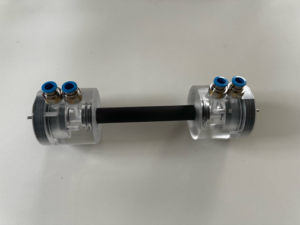
The tubular cell consists of three concentric layers:
- Outer carbon felt electrode — the anolyte side; AQDS electrolyte flows through the porous felt
- Membrane tube — a custom size-exclusion membrane that separates the two electrolytes
- Inner catholyte channel — Fe(CN)₆ electrolyte flows through the central channel, with a stainless steel current collector at the core
This geometry allows the cell to be manufactured as a continuous tube and assembled into multi-tube stacks for higher power output. The bench-scale system currently uses a single tube; scale-up to multi-tube configurations is part of the ongoing development roadmap.

The Membrane: Size-Exclusion as a Strategy
The membrane is arguably the most critical component of a flow battery. It must simultaneously allow fast ion transport for charge compensation and completely block the crossover of redox-active molecules. Crossover leads to self-discharge, capacity loss, and electrolyte contamination.
Most commercial flow battery membranes are based on ion exchange membranes — either cation exchange membranes (CEMs) or anion exchange membranes (AEMs). These are typically expensive, often fluorinated materials with environmental concerns. QuadriE has developed a novel alternative based on a size-exclusion principle.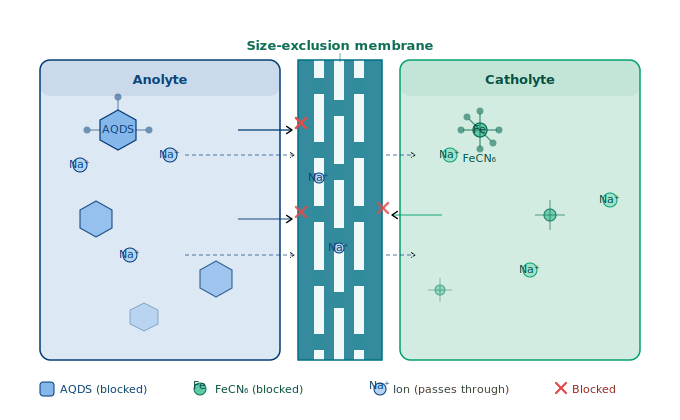
Modified size-exclusion membranes
QuadriE has systematically evaluated a range of size-exclusion membrane types for use in AORFBs. Through targeted modification of selected membrane materials, we have achieved outstanding RFB performance: exceptional selectivity against large redox-active anions combined with high ionic conductivity, enabling operation at very high current densities. The membranes are manufactured without fluorinated ion exchange polymers, offering a more sustainable and cost-effective alternative.
IP status
The membrane modification strategy and its application to AORFBs is considered patentable. A patent application is in preparation. QuadriE holds the IP as consortium leader under the NewBat collaboration agreement. Details of the specific membrane materials and modification process are not disclosed prior to patent filing.
Applications
Aqueous organic flow batteries are best suited to stationary, long-duration energy storage — applications where the ability to decouple power and energy, combined with a long cycle life and low maintenance, outweighs the lower energy density compared to lithium-ion batteries.

Target applications
- Residential and community-scale storage — behind-the-meter storage for solar PV, in combination with housing corporations and energy cooperatives
- Industrial peak-shaving — buffer storage to reduce peak demand charges
- Grid balancing — providing frequency regulation and local congestion relief
- Data centres and critical infrastructure — long-duration backup for high-demand consumers requiring non-flammable storage
- Repurposing existing tank infrastructure — the mild, pH-neutral chemistry makes it compatible with existing large-volume storage tanks
Port of Rotterdam: a compelling large-scale case
The Port of Rotterdam illustrates the scale potential of this approach. Typical oil storage tanks in the port hold approximately 10,000 m³. A single pair of repurposed tanks (20,000 m³ total) combined with a QuadriE power module would provide 100 to 200 MWh of long-duration energy storage, based on an electrolyte energy density of 5 to 10 kWh/m³. This is an asset-light model: the electrolyte infrastructure exists, the civil engineering is done, and only the electrochemical conversion unit needs to be added.
This opportunity is directly enabled by the mild chemistry of organic aqueous electrolytes. Vanadium flow batteries require concentrated sulfuric acid at low pH and are incompatible with standard tank materials. The QuadriE AORFB operates at near-neutral pH with non-corrosive, non-toxic electrolytes, making it compatible with existing carbon steel or coated tank infrastructure.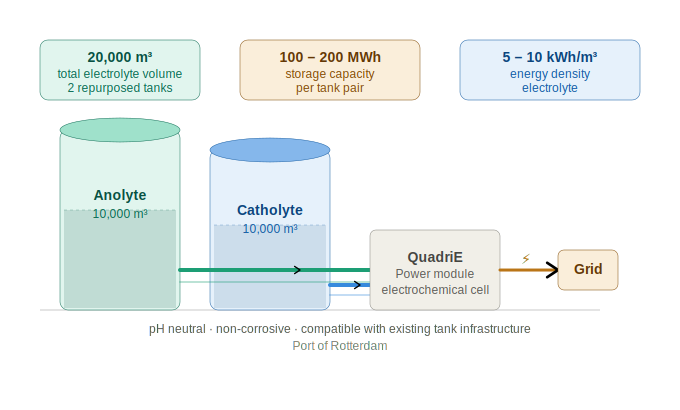
How QuadriE differs from other tank-conversion approaches
What sets QuadriE apart is not the application concept itself, but the underlying technology platform. Two specific innovations are decisive: the proprietary size-exclusion membrane strategy delivers very high selectivity at significantly lower cost than conventional ion exchange membranes, without fluorinated materials. The tubular cell architecture achieves a significantly higher membrane surface area per reactor volume than conventional plate-and-frame designs, enabling a more compact and modular power conversion unit.
Current end-use partners
- Woonstichting ‘thuis — housing corporation exploring flow battery storage for residential complexes
- Energie Samen Foodvalley — regional energy cooperative developing community-scale storage solutions
These partners provide real-world application context and end-user requirements that directly inform the technology development roadmap.
Want to Know More?
QuadriE welcomes contact from researchers, industrial partners, energy developers, and funding bodies with an interest in organic flow battery technology or electrochemical innovation more broadly.