
NewBat — Developing the Next Generation of Organic Flow Batteries
The NewBat project is a publicly funded research consortium developing a cost-effective and sustainable redox flow battery based on organic electrolytes and a novel tubular reactor cell design. The consortium is led by QuadriE and funded by TKI Urban Energy, with five Dutch partners combining academic, industrial, and end-user expertise.
| Project name | NewBat — Development of a cost-effective and sustainable flow battery |
| Funding | TKI Urban Energy (Topsector Energy, Dutch Ministry of Economic Affairs and Climate Policy) |
| Duration | April 2023 — March 2027 (4 years) |
| Consortium leader | QuadriE BV (project coordination and IP) |
| Partners | TU/e, MTSA Technopower, Woonstichting ‘thuis, Energie Samen Foodvalley |
| Technology | Aqueous organic redox flow battery (AORFB) |
| TRL trajectory | TRL 3 (proof of concept) → TRL 5 (validation in relevant environment) |
Project Objective
The central objective of NewBat is to develop an aqueous organic flow battery that is cost-effective, safe, and sustainable — and to validate it at bench scale under conditions representative of real-world applications in the built environment.
Two system-level goals drive the project: reducing the cost of energy storage by replacing vanadium with abundant organic molecules, and reducing cell complexity and cost through a novel tubular reactor cell architecture combined with low-cost size-exclusion membranes.
- Replace critical raw materials (vanadium) with abundant, renewable organic molecules
- Develop a novel tubular reactor cell architecture that reduces system cost and complexity
Work Packages
WP1: Identification of Alternative Membranes
Design and production of membranes specifically suited to organic redox flow battery chemistry. Focus on sulfonated polymers and size-exclusion materials that perform under mild aqueous conditions — avoiding the need for expensive fluorinated membranes such as commercial cation or anion exchange membranes. Led by TU/e.
WP2: Lab Scale Testing of Alternative Reactor Cell Design
Design and assembly of a tubular reactor cell based on the membranes developed in WP1. The concentric tubular architecture replaces conventional plate-and-frame configurations, enabling a more compact and scalable system. Led by TU/e in collaboration with QuadriE.

WP3: Bench Scale Research
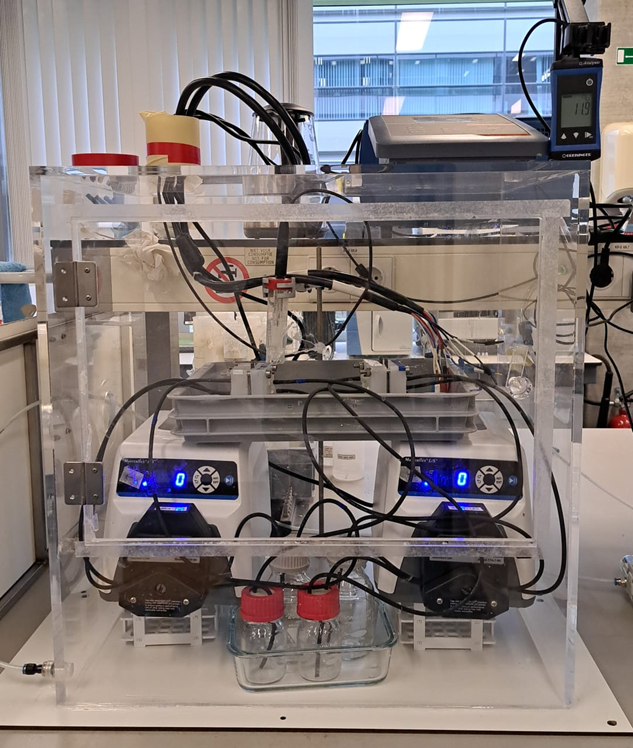
Integration of cell and membrane components into a full bench scale AORFB system. Long-duration testing under conditions representative of end-use applications, including demand and supply profiles from consortium partners ‘thuis and Energie Samen Foodvalley.
WP4: Business Case and Dissemination
Development of business cases for target applications, assessment of implementation aspects (regulatory, grid connection, space requirements), and dissemination of results via publications, seminars, and the QuadriE website. Led by QuadriE.
Progress & Key Results
As of January 2026, the NewBat consortium has completed the following key milestones:
- Membrane strategy validated — a proprietary size-exclusion membrane modification approach has been identified, delivering outstanding selectivity and high current density performance
- Tubular reactor cell concept confirmed at lab scale — the concentric tubular architecture has been validated and scale-up to bench scale is underway
- Electrochemical simulation model completed — a full simulation model for the AQDS/ferrocyanide system has been developed to support scale-up design
- Bench scale system design initiated — process design for the full bench scale unit is complete; construction is in progress
- Patent trajectory initiated — QuadriE has begun the patent application process for the proprietary membrane modification strategy
Consortium Partners
| Partner | Type | Role in NewBat |
|---|---|---|
| QuadriE BV | R&D company | Consortium leader, IP holder, reactor cell development |
| Eindhoven University of Technology (TU/e) | Academic | Membrane development and electrochemical research |
| MTSA Technopower | Industrial | Engineering, system integration, scale-up |
| Woonstichting ‘thuis | End-user | Residential energy storage application and user input |
| Energie Samen Foodvalley | End-user | Energy cooperative — renewable energy storage application |
Development Roadmap
Phase 1 — Proof of Concept to Bench Scale (current, 2023–2027): Development of reactor cell, membranes, and electrochemical model. Validation with end-user partners. Target: TRL 5 by end of project.
Phase 2 — Scale-up (planned, ~2027–2030): Bench scale to demonstration scale (TRL 5 → TRL 7). System integration with installers. Target: DEI programme or equivalent. MTSA as preferred installation partner; licence model for international rollout.
Phase 3 — Commercial rollout (target ~2030–2032): Full commercial deployment via licensing. QuadriE supplies reactor cells and engineering expertise; licensees handle installation and system integration.
Acknowledgement
This research is carried out within the framework of the NewBat project, supported by the TKI Urban Energy programme of the Dutch Ministry of Economic Affairs and Climate Policy under the Topsector Energy scheme.
More Information heading
For more information about the NewBat project or QuadriE’s flow battery technology, please visit our Technology page or get in touch directly.
Get in touch
Explore our NewBat project or visit our Technology page for more information.